
For multi-unit painting projects, hire one dedicated project manager and require a phased, line-item quote. That single decision resolves more scheduling conflicts, budget disputes, and resident complaints than any other choice you’ll make on the job.
Multi-unit painting logistics comes down to three things a contractor either has or doesn’t: a phasing plan that limits how much of the property is disrupted at once, a quote structure that maps to your reserve categories instead of one vague lump sum, and a documentation system that proves the work matches the spec. Before you sign anything, demand these three deliverables in writing:
- A phased schedule showing which buildings, floors, or units get painted in what order, and why.
- A QC and photo-documentation plan with named checkpoints tied to payment milestones.
- A resident communications plan covering notice timing, entry protocols, and an escalation contact.
Contractors who skip the dedicated project manager tend to push that coordination burden back onto you, the property manager, mid-project. Sigma Painting builds all three deliverables into its proposal process for multi-unit and new-construction developments, which is the standard this guide uses throughout.
Key Takeaways
Multi-unit painting logistics succeed when a dedicated project manager, phased scheduling, and reserve-study compatible quoting work together rather than being treated as separate concerns.
| Point | Details |
|---|---|
| Require one project manager | A single point of contact prevents scheduling gaps between leasing, maintenance, and the paint crew. |
| Choose phasing by building type | Horizontal, vertical, and unit-turn models each suit different layouts; hybrids fit properties running turnover and capital work together. |
| Insist on line-item quotes | Reserve-study compatible bids speed board approval and prevent lump-sum ambiguity later. |
| Tie payments to QC sign-offs | Photo documentation at each milestone protects both sides in warranty and dispute situations. |
| Sigma Painting as implementation example | Sigma Painting pairs a dedicated PM, line-item quoting, and daily QC photo documentation with cabinet refinishing capability for multi-unit and new-construction jobs across its service area. |
Table of Contents
- How Do You Scope a Multi-Unit Painting Program Before Requesting Bids?
- Which Phasing Model Fits Your Building Type?
- How Should You Communicate With Residents During Painting Work?
- What Prep and Product Specs Should You Require in the Contract?
- What Should You Look for When Evaluating Contractor Quotes?
- How Do You Verify Quality Control During Execution?
- How Long Should a Multi-Unit Painting Project Take, and What Drives Cost?
- What Should You Ask Sigma Painting or Any Contractor at RFP Stage?
- How Do You Coordinate Painting With Leasing and Maintenance for Unit Turns?
- How Should You Handle Material Delivery and On-Site Storage?
- How Do You Plan for Weather Delays or Tenant Availability Problems?
- How Does Painting Fit Into Broader Renovation and Maintenance Schedules?
- How Should You Plan Staffing and Labor for Multi-Unit Projects?
- What Environmental and Safety Rules Apply to Scaled Painting Projects?
- Where to Learn More and Get a Quote
- What This Guide Gets Right That Most Advice Misses
- Ready to Plan Your Multi-Unit Painting Project?
- Frequently Asked Questions
- Sources
How Do You Scope a Multi-Unit Painting Program Before Requesting Bids?
Bids only become comparable when every contractor is quoting against the same information. Before you send out an RFP, pull together the numbers that actually shape cost and schedule.
- Count units, buildings, and surface types. Note which units are occupied versus vacant, since vacant unit turns move faster and cost less per unit than occupied work.
- Flag known repair items. Water stains, prior lead paint, cracked stucco, or rotted trim all belong in the scope before bidding, not discovered mid-job.
- Build a budget-first, line-item scope. Structure it around the same categories your reserve study uses (exterior coatings, common areas, unit interiors) so board approval doesn’t require translation.
- Schedule a pre-construction meeting. Bring maintenance, leasing, and the contractor together to agree on sheens, touch-up tolerances, and who signs off on completed phases.
Pro Tip: Assign one internal staffer, not a rotating cast, to answer contractor questions during bidding. Inconsistent answers from your side are the single fastest way to get bids that aren’t actually comparable.
Which Phasing Model Fits Your Building Type?
Three models dominate multi-unit painting logistics, and the right one depends on your building’s layout more than its size.
- Horizontal phasing moves floor by floor or wing by wing, common in garden-style and mid-rise properties where crews can isolate one section while residents in another go about their day.
- Vertical phasing works stack by stack in high-rises, useful when exterior lift or scaffold access dictates the sequence more than resident convenience does.
- Unit-turn phasing applies to vacant-unit repaints between leases, where speed to occupancy matters more than coordinating with anyone currently living there.
- Hybrid models combine unit-turns with scheduled common-area work, which is typical on properties running turnover and capital improvements at the same time.
A single mobilization across the whole property costs less per square foot, but it also puts every resident through the noise and fumes simultaneously. Phasing by building or floor gives contractors natural quality checkpoints, catching a bad batch of caulk or a missed prime coat before it spreads across the whole property.
Pro Tip: Build weather buffers into the schedule from day one, especially for exterior phases. A contractor who quotes a hard end date with zero contingency is either padding the price elsewhere or planning to ask for more money later.
How Should You Communicate With Residents During Painting Work?
Complaints during occupied painting work rarely come from the work itself. They come from residents feeling ambushed by it. A structured notice cadence fixes that.
- Send a project announcement 30 days out describing the full scope and expected duration.
- Follow with 14-day and 7-day reminders through your resident portal, email, and physical door hangers.
- Post 48-hour entry notices for any unit-specific access, listing the exact date and window.
- Put up on-site signage at entrances and elevators noting which areas are active that day.
Advance notices combined with daily scheduling updates measurably reduce resident complaints compared to properties that notify once and go silent.
- Route all resident questions to a single escalation contact, not the crew on-site.
- Note pets, balcony furniture, and parked vehicles in the pre-entry checklist.
- Document any accommodation requests (mobility issues, medical sensitivity to fumes) and route them to the contractor’s PM directly.
What Prep and Product Specs Should You Require in the Contract?
A quote is only as good as the prep work behind it. Require these five steps in writing, in order: power wash, scrape, sand, caulk, prime. Skipping caulk or rushing the prime coat is where most premature paint failure originates, and it’s invisible until the first freeze-thaw cycle or humid summer exposes it.
For buildings older than a few decades, require moisture testing and lead testing before any scraping begins rather than after a problem surfaces.
- Specify durable, warranted formulations for exterior and high-traffic interior surfaces.
- Require low-odor, low-VOC products for occupied interior units to avoid complaints and reduce the rare need for temporary relocation.
- Demand batch consistency and documented brand and product names in the written quote, not “premium paint” as a line item.
- Specify number of coats and get warranty terms in writing, not verbally promised.
What Should You Look for When Evaluating Contractor Quotes?
Line-item detail is what separates a bid you can defend to your board from one you’ll be second-guessing in month two.
- Mobilization and setup costs, itemized separately from labor.
- Prep and repair work, broken out by category (caulking, patching, wood repair).
- Coatings and materials, with product names and coat counts specified.
- Labor, priced by phase or unit, not as a single portfolio-wide number.
- Lifts, scaffolding, or equipment rental, itemized so you can compare access costs across bids.
- Cleanup and final walkthrough, confirming it’s included rather than billed as an add-on.
Reserve-study compatible, line-item quotes accelerate board approvals because they map directly onto existing budget categories instead of requiring someone to translate a lump sum after the fact.
Score every proposal on whether it names a dedicated project manager, defines QC checkpoints with photo logs, and lists insurance certificates and references from comparable multi-unit jobs. Pro Tip: Reject any bid with a vague scope line like “paint as needed” or one missing a defined escalation path for disputes. Both are early warning signs of change-order creep later.
How Do You Verify Quality Control During Execution?
Quality control on a multi-unit job isn’t a final walkthrough. It’s a daily habit.
Assign a QC supervisor per active phase, and have that person run a daily checklist: coverage consistency, drying time compliance, clean lines at trim and fixtures, and confirmation that the prep sequence was actually followed, not skipped under schedule pressure.
- Photograph completed sections at each milestone, before moving to the next phase.
- Use those photos to resolve disputes over coverage, color match, or damage claims months later.
- Tie progress payments to signed-off milestones, not to elapsed time.
- Run punch-list walkthroughs at the end of each phase, not just at project close.
Daily checklists paired with photo documentation and phase sign-offs catch problems while a crew is still on-site to fix them, instead of after they’ve moved to the next building. Pro Tip: Ask for photo documentation to be timestamped and organized by unit or phase number, not dumped into one folder. You’ll need to find a specific photo fast if a warranty question comes up eight months from now.
How Long Should a Multi-Unit Painting Project Take, and What Drives Cost?
Timelines vary by scope, but interior unit turns commonly run a few days each, while exterior repaints on a medium-sized property often stretch several weeks depending on crew size, access difficulty, and weather.
Cost is driven less by square footage than by these factors:
- Number of separate mobilizations required by your phasing plan.
- Scaffold or lift rental, especially on mid-rise and high-rise exteriors.
- Extent of prep and repair work uncovered once scraping begins.
- Paint grade and coat count specified in the contract.
- Access difficulty (locked units, limited parking, elevator scheduling).
- Any after-hours or weekend work requested to accommodate residents.
Phased projects can run modestly higher in cost, often estimated around 10 to 20 percent more than a single mobilization, mainly from repeated setup. That premium tends to pay for itself through fewer complaints, less lease turnover tied to disruption, and fewer disputed change orders. For budgeting help, Sigma Painting’s quote calculator can frame early cost conversations with your board before you go to formal bid.
What Should You Ask Sigma Painting or Any Contractor at RFP Stage?
Sigma Painting’s approach to multi-unit and new-construction work is built around the same three deliverables this guide opens with: a dedicated project manager per account, reserve-study compatible line-item quotes, and daily QC with photo documentation tied to phase sign-offs. Every project also starts with a pre-construction meeting establishing written standards for sheens, materials, and finish, so there’s no ambiguity later about what “done” means.
Cabinet and kitchen refinishing capability matters here too, since many unit-turn scopes bundle wall repainting with cabinet work rather than treating them as separate contracts.
At RFP stage, ask any contractor, Sigma Painting included:
- How is phasing sequenced, and who decides the order?
- What does the QC checkpoint and photo-documentation schedule look like phase by phase?
- Can the quote be restructured to match our reserve study’s line items?
Readers ready to move forward can start with a cabinet painting consultation or request a broader commercial painting proposal.
How Do You Coordinate Painting With Leasing and Maintenance for Unit Turns?
Unit turns fail on logistics more often than on paint quality. The painting crew shows up, but maintenance hasn’t finished a repair, or leasing has already shown the unit to a prospective tenant who’s now walking through wet trim.

Fix this by building painting into the turn checklist itself, not treating it as a separate vendor to schedule around. Maintenance should flag any repairs (drywall patches, door adjustments, plumbing fixes) that need to happen before paint goes on, since painting over an unresolved repair means redoing both jobs. Leasing needs a hard cutoff date for showings once a unit enters the paint queue, and painting crews need confirmed vacancy dates before they show up, not an estimated move-out that slips by three days.
The properties that turn units fastest treat this as a single workflow with one owner, usually the property manager or a designated coordinator, who confirms vacancy, greenlights maintenance sign-off, and schedules the paint crew in that order. Same-day occupancy turn workflows depend on crew sizing that matches unit counts and material staged in advance, including pre-cut trim templates so crews aren’t measuring and cutting on-site.
Build in a buffer of at least one day between maintenance completion and paint start. Rushing a coat onto freshly patched drywall before it’s fully cured is a common cause of visible flaws that show up weeks later, right when a new tenant moves in.
How Should You Handle Material Delivery and On-Site Storage?
Paint, primer, caulk, and supplies for a multi-building project add up to a lot of material, and where you stage it matters as much as when it arrives.
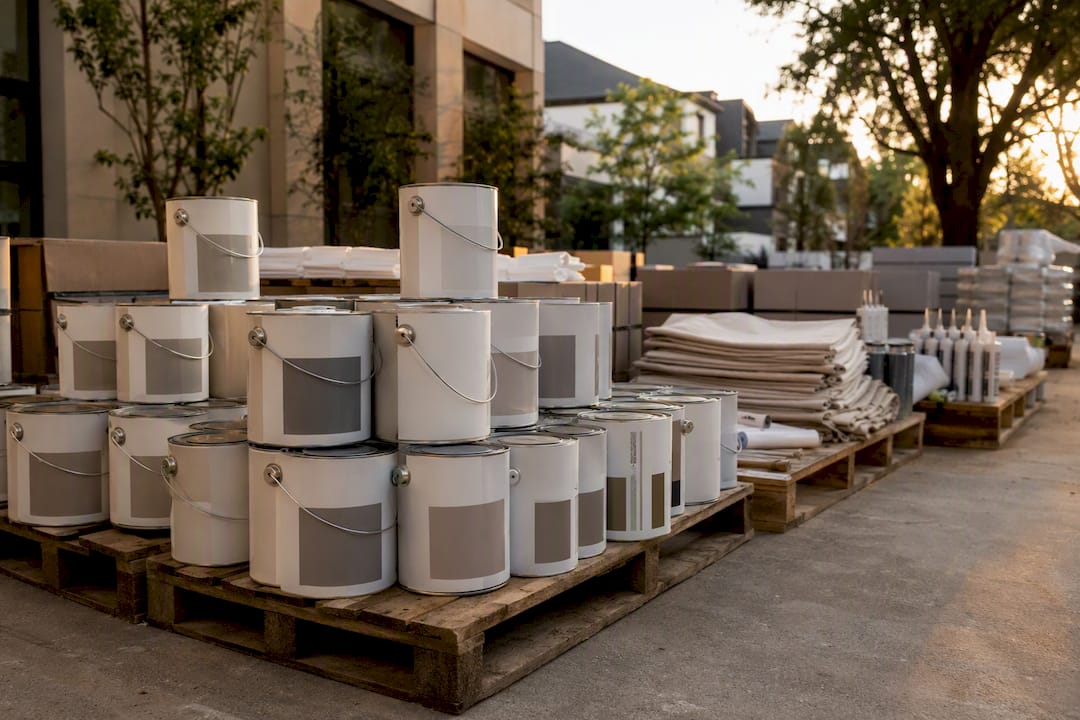
Deliveries scheduled to arrive in bulk, all at once, tend to create clutter in common areas and give residents a reason to complain before a single wall gets painted. Staggered deliveries, timed to match the phasing schedule, keep only the materials needed for the active phase on-site at any given time. A contractor running horizontal phasing floor by floor should be receiving materials floor by floor too, not stockpiling six weeks of paint in a shared hallway.
Designate a single, secured storage area, ideally a vacant unit, storage room, or fenced exterior space, rather than letting crews stage materials wherever is convenient that day. This matters more than it sounds: unsecured paint cans and solvents in common areas are both a liability risk and a common source of resident complaints about smell and appearance.
Ask your contractor how they plan to store flammable materials and where cleanup waste goes at the end of each day. A crew that leaves drop cloths, empty cans, and rollers visible overnight in a lobby is signaling disorganization that usually shows up elsewhere in the project too. Sigma Painting’s site plans specify a locked storage location and daily cleanup protocol as part of the standard project setup, which keeps common areas usable throughout the work.
How Do You Plan for Weather Delays or Tenant Availability Problems?
Every multi-unit painting schedule eventually collides with something outside anyone’s control: three days of rain during an exterior phase, or a resident who can’t accommodate the entry window you gave them two weeks ago.
Build contingency into the contract itself, not just the calendar. Ask your contractor to quote a schedule with explicit weather buffer days built into exterior phases, especially if the project runs through a season with unpredictable precipitation. A contractor unwilling to include buffer days is either underbidding the timeline or planning to bill you for the difference later as a change order.
For tenant availability delays, build a rescheduling protocol into your resident communications plan from the start. If a resident can’t accommodate a 48-hour entry notice, define in advance how many reschedule attempts are reasonable before that unit gets moved to the end of the phase rather than holding up the whole floor. Escalate persistent access refusals to your leasing or legal team early, since letting one unit stall an entire phase creates costly crew idle time.
Keep a short list of alternate tasks, common-area touch-ups, exterior trim work, storage room organization, that a crew can shift to on short notice if a specific unit or building section becomes unavailable. That flexibility keeps a crew productive instead of paying for idle labor while you sort out access.
How Does Painting Fit Into Broader Renovation and Maintenance Schedules?
Painting rarely happens in isolation on a multi-unit property. Roof replacements, window upgrades, elevator modernization, and routine maintenance all compete for the same buildings, the same access windows, and often the same contractor coordination bandwidth.
Sequencing matters here. Painting should generally follow any trade work that disturbs walls, ceilings, or exterior surfaces, not precede it. A common and costly mistake is painting a unit or exterior wall before electrical or plumbing work that requires cutting into that same surface. Coordinate your painting contractor’s schedule against your capital improvement calendar before locking in dates, ideally at the same pre-construction meeting where you’re setting finish standards.
For portfolio-level properties running multiple capital projects simultaneously, a shared project calendar visible to every trade and to leasing and maintenance staff prevents the kind of double-booking that stalls a phase for a week while everyone figures out who was supposed to be where. Coordinated property-management practices that plan maintenance and improvement projects together tend to see fewer scheduling conflicts than properties that let each trade schedule independently.
If your building is also tackling flooring, trim, or door replacement alongside painting, sequence painting after rough carpentry but before final flooring installation to avoid drips and overspray on new floors. Minimal-disruption renovation approaches that bundle finish work into tight, predictable windows apply directly to painting scheduling too.
How Should You Plan Staffing and Labor for Multi-Unit Projects?
Crew sizing is where a lot of multi-unit painting bids quietly fail. A contractor who staffs a 40-unit turnover project the same way they’d staff a single-family repaint will blow through your timeline, phase by phase, without ever explaining why.
Ask for crew counts tied specifically to your unit counts and phasing plan, not a generic “we’ll send a team.” A same-day unit-turn workflow needs enough hands to complete prep, priming, and finish coats within the occupancy window your leasing team has committed to, which means crew sizing scaled to unit counts with materials staged in advance rather than assigned reactively as delays pile up.
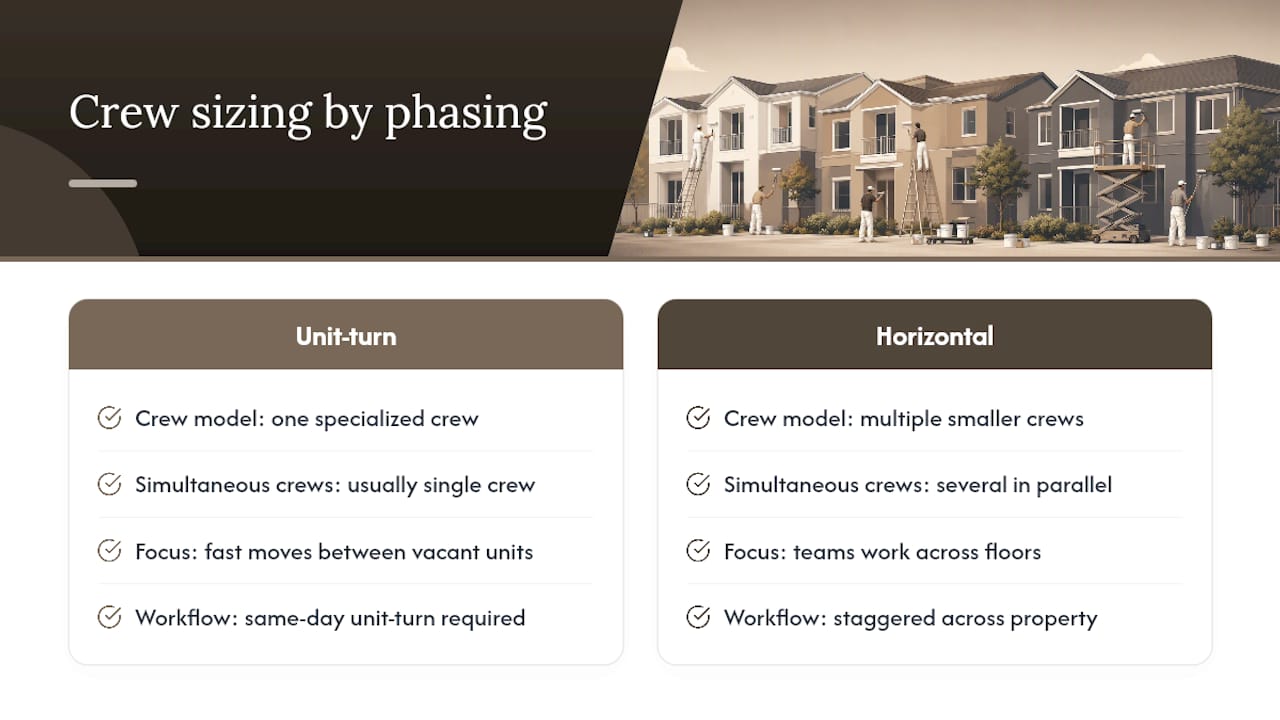
Labor allocation should also flex with your phasing model. Horizontal phasing across a large property can run multiple smaller crews in parallel across different floors, while unit-turn work often benefits from one specialized crew that moves fast between vacant units using consistent, repeatable steps. Ask your contractor how many crews will be on-site simultaneously and how that number changes if a phase falls behind schedule. A vague answer here usually means no real staffing plan exists, just an assumption that more people can be found if needed.
What Environmental and Safety Rules Apply to Scaled Painting Projects?
Painting a single unit and painting an entire property carry different regulatory weight. Scale changes what’s required, not just what’s prudent.
Lead paint is the biggest one. Buildings constructed before the 1980s often require lead testing before any scraping or sanding begins, and disturbing lead-based paint without proper containment creates both a health hazard and a liability exposure that dwarfs the cost of the paint job itself.
Ventilation and product selection matter more at scale too. Low-odor, low-VOC formulations reduce complaints and the rare need for temporary relocation in occupied buildings, and they matter even more when multiple units or floors are being painted simultaneously and fumes have nowhere to dissipate between phases.
On the safety side, scaffold and lift use on mid-rise and high-rise exteriors introduces fall-protection requirements that don’t apply to ground-level residential work. Confirm your contractor’s crews are certified for the specific equipment your building’s height requires, and ask for proof of insurance that specifically covers elevated work, not just general liability. Flammable material storage, covered earlier in the context of on-site staging, also falls under this umbrella: improperly stored solvents in a shared building are a fire-code issue, not just an organizational one.
Where to Learn More and Get a Quote
- Commercial painting services for portfolio-scale work.
- Choosing a painting contractor checklist for vetting proposals.
- Property management best practices for coordinating capital projects.
What This Guide Gets Right That Most Advice Misses
Most advice aimed at property managers treats contractor selection as a shopping exercise: compare three quotes, pick the cheapest reasonable one, move on. That approach fails on multi-unit projects specifically because the biggest costs aren’t in the paint. They’re in the coordination failures that show up after the contract is signed, a missed entry notice, a phase that stalls because maintenance wasn’t ready, a dispute over coverage with no photo record to settle it.
The research on this consistently points the same direction: phased scheduling with clear checkpoints beats speed every time tenant satisfaction and dispute rates are measured. Yet plenty of property managers still default to the lowest bid because it’s easier to defend to a board in the moment.
What actually protects you is writing the operational requirements into the contract itself, not trusting a handshake agreement that a contractor will “communicate well” or “keep things clean.” Reserve-study compatible quotes, named QC checkpoints, a defined communications cadence, these aren’t nice extras. They’re the difference between a project you manage and one that manages you.
Ready to Plan Your Multi-Unit Painting Project?
Reading a playbook is one thing. Getting a contractor who actually follows it is another. Sigma Painting runs every multi-unit and new-construction project through the same structure this guide describes: a dedicated project manager assigned to your account, line-item quotes built to match reserve-study categories, and daily QC with photo documentation tied to phase sign-offs, so your board sees progress, not surprises.
Unlike a single-crew operation juggling your project alongside a dozen unrelated jobs, Sigma Painting structures its process around portfolio-level coordination from the first pre-construction meeting through final walkthrough. Kitchens needing cabinet refinishing, common areas needing durable coatings, and vacant units needing fast turns all get scheduled under one plan instead of three separate vendor conversations. If you manage a property in the Greater Toronto Area and want a phased, line-item proposal for your next painting program, start with Sigma Painting’s interior painting services page or run your numbers through the quote calculator to bring a real budget range to your next board meeting.
Frequently Asked Questions
What is the best phasing model for a large apartment complex? It depends on layout. Garden-style and mid-rise properties usually do best with horizontal phasing by floor or wing, while high-rises often need vertical phasing tied to scaffold or lift access. Properties running unit turnover alongside common-area work typically need a hybrid approach.
How much notice should residents get before painting begins in their unit? A common cadence starts with a 30-day project announcement, followed by 14-day and 7-day reminders, and a firm 48-hour notice before crews enter a specific unit.
What should be in a reserve-study compatible painting quote? Line items that mirror your reserve study’s categories: mobilization, prep and repairs, coatings by area, labor by phase, equipment rental, and cleanup, priced separately rather than bundled into one number.
How long does a multi-building exterior repaint typically take? For a 50-unit property, exterior work often runs several weeks depending on crew size, access difficulty, and weather. Interior unit turns are much faster, typically one to three days each.
Does phased painting cost more than painting everything at once? Often modestly more, since phasing requires repeated mobilizations. Many property managers find that cost offset by fewer complaints, less turnover, and fewer disputed change orders.
Sources
- Multi-Family Painting Best Practices Part 2: Advanced Strategies for 2026 | World Pro Painting
- Multi-Family Repainting: How to Minimize Tenant Disruption | Moorhouse Blog
- HOA & Multifamily Painting Company | AllPro Painters